National Healthcare Decisions Day

Generic selectors
Exact matches only
Search in title
Search in content
Post Type Selectors

National Healthcare Decisions Day (NHDD) is represented annually in April and is an initiative created to inspire, educate, and empower the public about the importance of advance care planning. NHDD was designed to encourage someone to express their wishes regarding healthcare and for providers and facilities to respect those wishes, whatever those wishes might be.

The pandemic has been a reminder that healthcare affects everyone of all ages. It impacts that patient, the person’s family, and the facility taking care of the person. The focus on advance care planning has been highlighted through these unique times.

Advanced care planning includes completing an advance directive (living will), appointing a healthcare power of attorney (someone to make healthcare decisions if the person can not speak for themselves), and the person sharing their choices with their family and loved ones.

Another aspect of advanced care planning is Psychiatric Advanced Directives (PADs). PADs are legal documents detailing a person’s preference for future mental health treatment, including specific choices about medications and hospitalizations and the refusal of consent to either. PADs help the person identify an individual to make treatment decisions if that person is in a crisis and unable to make decisions. In NC, PADs are also known as an “Advance Instruction for Mental Health Treatment .”An Advance Instruction for Mental Health Treatment remains valid until the person who created it revokes it.

There are numerous benefits to having and completing advanced care directives, including enabling proper care and possibly preventing involuntary treatment. When families are informed, and up to date on a person’s advanced care directives, the family can better advocate for their loved ones.
Medicaid Managed Care Updates

Generic selectors
Exact matches only
Search in title
Search in content
Post Type Selectors

NC Medicaid Rate Reductions Effective Oct. 1, 2025

Fee schedules impacted by rate reductions will be released.

Oct. 1, 2025. Rates are subject to change if additional appropriations are

made.

North Carolina has expanded health care coverage to more people. You might be one of them. Check to see: North Carolina Expands Medicaid | NC Medicaid

NC Medicaid Managed Care Overview Video: Watch this brief video to learn more about the different health plan types for NC Medicaid Managed Care beneficiaries. These include Standard Plans, Tailored Plans, EBCI Tribal Option, the Children and Families Specialty Plan and NC Medicaid Direct.

New Primary Care Provider Change Request Form for Members in Managed Care Prepaid Health Plans: In collaboration with primary care providers (PCPs), the NC Medicaid Managed Care Prepaid Health Plans (PHPs) have created a new standardized PCP Change Request Form for members who wish to change their primary care assignment throughout the year. A link to each health plan’s form can be found here:

As a reminder, beneficiaries can change their PCP/Advanced Medical Home (AMH) without cause twice each year. For more information, please see New Primary Care Provider Change Request Form for Members in Managed Care Prepaid Health Plans.

NC DHHS

The Children and Families Specialty Plan will launch December 1, 2025. Visit health plan types to learn more at Health plan types | NC Medicaid Managed Care.

Provider Resource Requirements

Generic selectors
Exact matches only
Search in title
Search in content
Post Type Selectors

1. The North Carolina Medical Board (NCMB) allows you to access The Licensure Gateway portal to apply for a North Carolina medical license, complete a license renewal, manage licenses, and update licensee information.

2. Were you successful with getting signed up for the NCDAVE System? All clinicians in NC should register with NCDAVE. Register for NCDAVE today

3. NC Tracks Training

4. MLNConnects newsletter

5 MOC IV NC Maintenance of Certification :  The North Carolina AHEC Practice Support Program is an approved Project of the North Carolina Maintenance of Certification (NC MOC) Program, an approved sponsor of the American Board of Medical Specialties’ (ABMS) Multi-specialty Portfolio Program (MSPP). Most ABMS Member Boards recognize this participation as an option to meet Part IV requirements. The National Commission on Certification of Physician Assistants (NCCPA) also accepts NC MOC credit for physician assistants. Through this approval, physicians and physician assistants who work with an NC AHEC Practice Support coach to improve care for patients will meet the requirements of their specialty boards to maintain certification in their specialties.

Financial Sustainability Training Events

Generic selectors
Exact matches only
Search in title
Search in content
Post Type Selectors

A Primer for Practice Managers

  • Part 1 Highlights Strategic Planning, Budgeting, and Financial Reports with Key Performance Indicators.
  • Part 2 includes education on Effective Payer Management, Revenue Cycle Management, and how to conduct a financial projection for a new program or service.

Find more training opportunities

Sleep Awareness Week is March 13 – 19, 2022

Generic selectors
Exact matches only
Search in title
Search in content
Post Type Selectors

Sleep Awareness Week is March 13 – 19, 2022, and it is a period to use as a call to action for personal well-being. It is the perfect time for everyone to recognize the importance of sleep as a crucial measure of overall health and wellness.

Please use this vital reminder to implement healthy sleeping habits and reflect on practices to help you have a good night’s rest. It is not a coincidence that sleep awareness week begins on March 13th, which is the beginning date of Daylight-Saving Time, when most Americans change their clocks and lose an hour of sleep.

The National Sleep Foundation stresses that adults need seven to nine hours of sleep per night and any less could pose serious consequences to a person’s health and safety. Sleep helps people recover from illness or injury, cope with stress, and solve problems. Common sleep-wake disorders include insomnia (having problems falling or staying asleep which can lead to anxiety and depression), nightmares (this usually happens during Rapid Eye Movement sleep and brings up feelings of distress or terror generally related to a traumatic event), sleep terrors (any single image memory – not like a nightmare but these single images can be so terrifying that you may shake or scream. When the sleep terror ends, you calm down and return to normal sleep.)

The complex relationship between sleep and psychiatric disorders means that treatment for both issues can go hand-in-hand. There are steps to improve sleep which may even form part of a preventive mental health strategy. A medical doctor or psychiatrist can review the potential benefits and risks of different types of treatments, including prescription medications. They can provide tailored care, including in situations with multiple co-occurring physical or mental health issues. Good sleeping habits, relaxation techniques, sleep restriction (limiting the amount of time in bed) and exercise are treatment options for sleep..

February 14th is Designated Congenital Heart Defect Awareness Day.

Generic selectors
Exact matches only
Search in title
Search in content
Post Type Selectors

February 14th is designated Congenital Heart Defect Awareness Day. This is an annual campaign to remember and honor anyone born with a heart defect. This campaign also honors all of the families and friends touched by children with heart defects along with the medical professionals caring for and conducting research to treat and prevent children born with heart defects.

1 out of every 100 newborns are affected by Congenital Heart Defects / Disease. CHDs are conditions that are present at birth and can affect the structure of a baby’s heart and how that baby’s heart works. These conditions can range from a small hole in the heart (considered mild) to missing or poorly formed parts of the heart (severe). Generally, the cause of CHD is not known but if a child has CHD is becomes evident during the first few months after birth during a routine medical checkup. Some babies have very low blood pressure shortly after birth and some babies have breathing difficulties, poor weight gain, or feeding problems.

An article published in Everyday Health noted “pediatricians should consider screening children with CHD and other chronic health illnesses for mental health problems”. This article also stated CHD patients are significantly more likely to have depression, anxiety, and attention deficit hyperactivity disorder than children not diagnosed with CHD. Dr. Lopez reported “that non-Hispanic Black, Hispanic, and Asian American children were significantly less likely to be diagnosed or treated for anxiety and depression than white children, despite the fact that the prevalence of these conditions are thought to be the same across all races and ethnicities in the general population”. Most children with simple defects survive into adulthood. Their exercise capacity may be limited, but these children grow up to live normal or nearly normal lives. Children who had more complex problems had more developmental delay or other learning difficulties.

January is Designated National Blood Donor Month

Generic selectors
Exact matches only
Search in title
Search in content
Post Type Selectors

This is to honor voluntary blood donors while encouraging more people to give more blood. According to the American Red Cross, the winter is “one of the most difficult times of the year to collect enough blood products to meet patient needs.” People stop donating blood during the holidays and during the cold and flu season because more people get sick.

Blood is needed every two seconds in the U.S. to help patients battling illness and injury. COVID-19 cases are continuing to rise across the US and blood, platelet and plasma donations are continuing to be tested for COVID-19 antibodies.

For a limited time, the American Red Cross is including sickle cell trait screening on all self-identified African American donors. Compatible blood types can be identified quicker. This helps sickle cell patients and African American donors have additional health insight regarding their health information. But, this testing does not diagnose sickle cell disease.

Everyone can still donate blood as long as you don’t have symptoms of COVID-19, feel well and after receiving a COVID-19 vaccine. You will need to know and be able to give the name of your COVID-19 vaccine’s manufacturer ( Johnson & Johnson, Moderna, and Pfizer).

Giving blood can help your mental state by providing an altruistic interaction resulting from doing something good for someone else. Donating blood has shown to have a positive effect of greater happiness and better health. The happiness level is increased through shifting aspirations and empathic emotions. Donating blood reduces stress, enhances emotional well-being, minimizes negative thoughts and feelings and provides a sense of belonging while reducing feelings of social isolation.

December is National National Drunk and Drugged Driving Awareness Month

Generic selectors
Exact matches only
Search in title
Search in content
Post Type Selectors

December is National 3D Month or National Drunk and Drugged Driving Awareness Month, which stemmed from MADD (Mothers Against Drunk Driving), and the mission statement expanded to include drug-impaired driving. This particular month was selected due to the spike in traffic-related deaths between Thanksgiving and New Year’s Day.

At the beginning of this year’s holiday shopping, there was a decrease in online purchases and an increase in face-to-face purchases, which reflects that many people are interested in being around others verses than being online. It can also be an educated guess that there is probably an increase in social gatherings with the options of drinking or using drugs since social groups or anything face-to-face was not encouraged last year.

North Carolina is one of the eighteen states that adopted the standard; if any detectable amount of controlled substance is found in a driver’s system, other than legally prescribed medicine, the driver will be charged with drugged driving. Compared to drunk driving, drivers are allowed a small amount of alcohol in their system and can still drive.

Anxiety, depression, PTSD, conduct disorder, anti-social personality disorder, and stress are some factors that may contribute to drunk and drugged driving.

Cognitive Behavioral Therapy is a short-term, solution-oriented approach to help identify negative thoughts/behaviors and replace them with positive thoughts/behaviors. Motivational Interviewing is also a brief-client-centered approach concentrating on improving and strengthening a client’s motivation for change. This specific technique is selected when someone is less motivated or ready for a change in parallel with other therapy modalities.

The engagement of these two common modalities can help someone make better choices to avoid drunk and drugged driving.

The Armed Services YMCA Established Veterans and Military Families Month

Generic selectors
Exact matches only
Search in title
Search in content
Post Type Selectors

The Armed Services YMCA established Veterans and Military Families Month in 1996 and is recognized annually during November. As we know, veterans and military families make tremendous sacrifices, including separating from their families and adjusting to new communities, countries, and new family living situations.

Fort Liberty covers approximately 500 square miles with 146,000 acres dedicated to training, supporting nearly 54,000 troops and 14,000 civilians who work on post at Fort Liberty. This military installation supports about 260,000 military families, military retirees, contractors, and others.

The ASYMCA at Fort Liberty assists 62,500 active-duty soldiers, 76,486 family members, and 94,939 retired Army, Air Force, Navy, and Marines stationed or living in Cumberland and surrounding counties in North Carolina.

The overall goal is to ensure that veterans’ and military families’ daily interactions are constant within our regional community. We hope all families feel supported and celebrated.

Some national services that are highlighted during Veterans and Military Families Month are:

  • Sesame Street for Military Families Free App – This App addresses deployments, homecoming, self-expression, and injuries.
  • A ‘Military Family Month’ downloadable packet from the Armed Services YMCA at www.asymca.org The information typically contains a Military Family Month Poster, a Message from the President and National Executive Director; Military Family Month Program Suggestions; and Guidelines for the annual art and essay contests.

SAMHSA has a Service Members, Veterans, and their Families Technical Assistance (SMVF TA) Center: https://www.samhsa.gov/smvf-ta-center This center serves as a national resource to support states, territories, and local communities in strengthening the capacity to address the behavioral health of military and veteran family needs.

Health Literacy Month is Observed in October

Generic selectors
Exact matches only
Search in title
Search in content
Post Type Selectors

HRSA (Health Resources and Services Administration) defines health literacy as the degree to which individuals have the capacity to obtain, process, and understand basic health information needed to make appropriate health decisions.

Some factors which can affect health literacy are: understanding how the health care system works; knowledge of medical words; reading, writing, and number skills; ability to communicate with health care providers; ability to find health information, which may require computer skills; physical or mental limitations; and personal factors, such as education, language abilities, age, culture, and income.

A September 28, 2021 article from NC Policy Watch shows a comparison of the number of residents who lack basic literacy skills in different counties in NC and the percentage of residents in that same county who live below the poverty line.

Social determinants of health plays a role with health literacy. Health care access and quality helps people to receive timely, high-quality services, which is important for both physical and behavioral health services. This is really important in rural settings when appointments might not be easily accessed and this could hinder or improve communication depending on the relationship of the provider and the patient.

Another social determinants of health which can affect health literacy is education access and quality. If a child or adolescent has the stress of living in poverty, this can affect their brain development making it harder for them to succeed in school especially in reading and math. Consequently, the child or adolescent is less likely to graduate from high school. If a child or adolescent has access to high-quality educational opportunities, there is a stronger possibility for better health literacy; both physical and behavioral health outcomes.

Health literacy and acknowledging social determinants of health is something that can empower us as a community together.

September is National Cholesterol Education Month

Generic selectors
Exact matches only
Search in title
Search in content
Post Type Selectors

High cholesterol, which causes heart attacks and strokes, is one of the major risk factors for heart disease.

High cholesterol comes from what you eat, like food that are high in trans-fat and saturated fats. An example of these foods are full-fat dairy products, poultry, meat and tropical oils like coconut oil, palm oil and palm kernel oil. Our body makes all the cholesterol that is needed through the liver. Trans-fat and saturated fats causes the liver to make more cholesterol than it normally would. The more excess cholesterol that is created, the more it will build up in the walls of the arteries eventually making the arteries become narrower and blood flow to the heart slows down or becomes blocked.

Other factors that can affect cholesterol levels are: being inactive (regular physical activity may lower your bad cholesterol (LDL) and raise your good cholesterol (HDL), having relatives with high cholesterol, smoking, being older because our cholesterol levels naturally rise as we age, smoking and stress (long term stress raises a person’s blood cholesterol levels generally because when people are stressed they are more likely to eat fatty foods).

Some ways to lower your stress level, which helps with lowering your cholesterol levels are to reduce your stress triggers (which could be practicing time management, setting priorities and pacing yourself). You can also practice relaxation techniques everyday which can vary from deep breathing, mindful mediation, incorporating art and music. Visualization can help you take a journey to a calming, peaceful place or situation. This incorporates using your touch, smell, sound and sight senses.

It is important to remember stress relief strategies takes some experimenting and practice but it is a great way to help manage your cholesterol and overall well-being.

Mobile Outreach Clinic Brings Health Access to Community’s Vulnerable

Generic selectors
Exact matches only
Search in title
Search in content
Post Type Selectors

With Funding Help from Southern Regional AHEC and NC AHEC

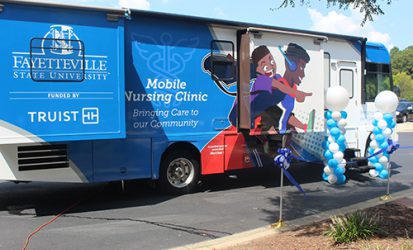
On Tuesday, August 24th, a ribbon-cutting ceremony took place at Fayetteville State University’s Southeastern NC Nursing Education and Research Center, celebrating “Bringing Care to the Community” and revealing the Beyond the Bedside Mobile Nursing Clinic. Its financial sponsor and FSU partner, TRUST, along with Clinical Site Development Grant funding from Southern Regional AHEC through the NC AHEC Program, helped to bring the mobile unit, housed within a retrofitted RV, to realization. Soon, the Bronco-blue-and-white mobile clinic, clad with the buoyant, bright artwork of FSU student Albert Bass, will travel to the areas of Cumberland County in most need, to meet the basic healthcare needs of our citizens. 

At the ceremony, FSU Chancellor Darrell T. Allison noted that the unit is a win/win for the campus and the community, especially during a pandemic. It offers an affordable solution to those who need healthcare, but do not have the transportation necessary to travel to their doctor’s office. The service also provides hands-on clinical experiences to nursing students attending FSU. “We celebrate this momentous occasion to further prove that we are doing what we said we would, by serving the citizens of Cumberland County”, he told the guests on Tuesday afternoon. “The people of our community will come to see this as a symbol of FSU’s example and service.”

Southern Regional AHEC is proud to be part of this important project that coincides with our organization’s mission to increase access to care while increasing the number and diversity of healthcare professionals in our region.